Class IV Laser Therapy
High-power Class IV laser for deeper photobiomodulation — microcirculation, mitochondrial support, and tissue-level recovery. Adjunctive support to the regenerative protocol, used where the published response justifies the energy density.
- Class
- Photonic
- Source
- Class IV laser (Remy FX)
- Penetration
- Mid-deep tissue
- Role
- Recovery adjunct
01 About
What it is.
Class IV laser therapy delivers higher-energy photobiomodulation than LED, with the energy density and depth of penetration to reach mid-to-deep musculoskeletal tissue. The mechanism is the same as red light therapy — cytochrome c oxidase activation in mitochondria, increased ATP, modulated inflammation — but at a clinical dose that LED cannot match.
At Apex we use Class IV laser as an adjunct to the regenerative protocol: tissue support for chronic MSK pain, post-injection recovery, and selected indications where the published trial data demonstrates a meaningful effect. We do not sell laser as a cure for everything.
02 How it works
How Class IV laser works.
The same photobiomodulation mechanism as LED red light: photon absorption by cytochrome c oxidase, transient ATP up-regulation, and modulation of reactive oxygen species. The clinical difference is dose. Class IV laser delivers calibrated higher energy density — sufficient to penetrate fascia, muscle, tendon, and into joint structures where LED cannot reliably reach.
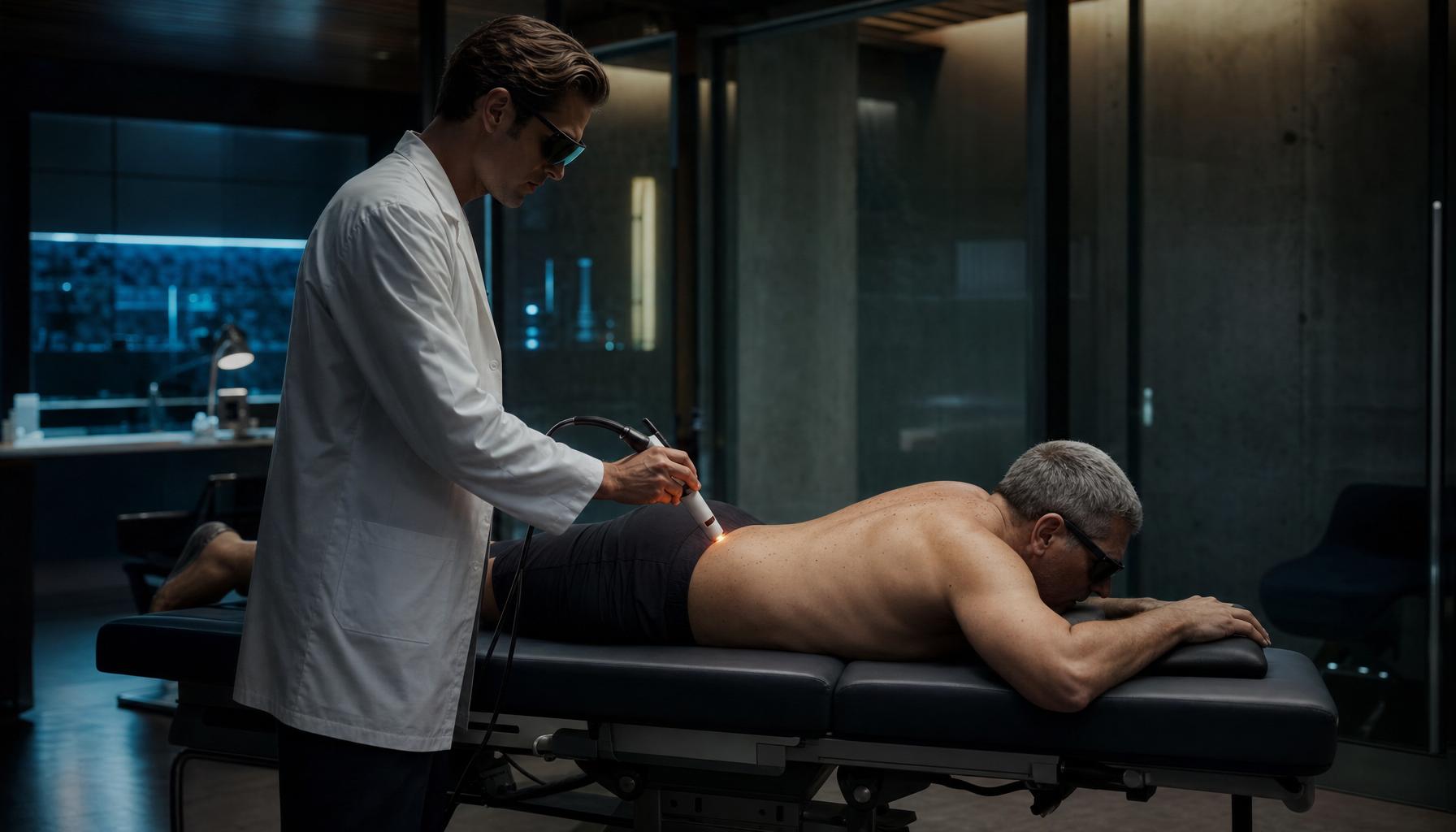
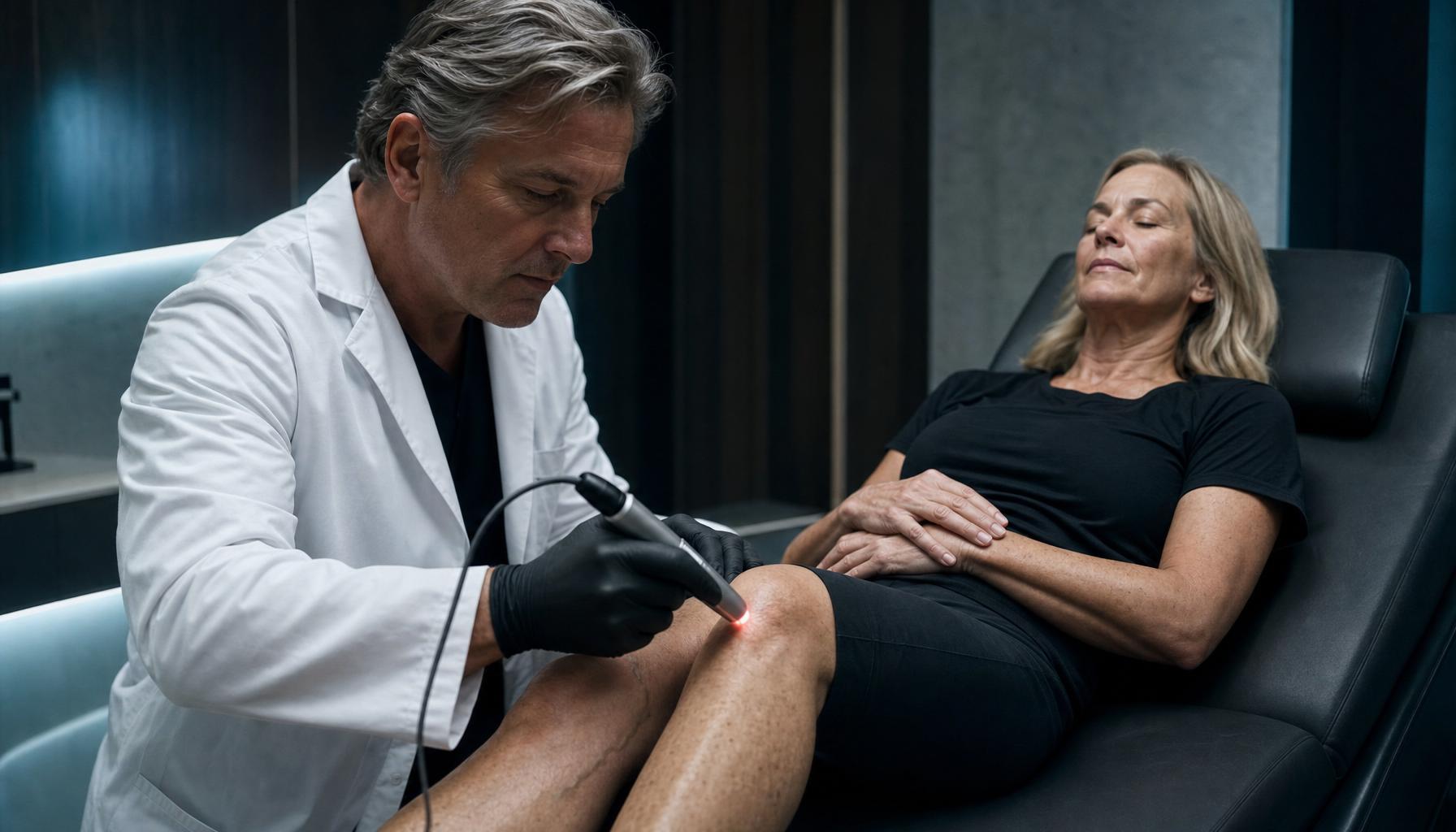
The tradeoff is heat. A skilled clinician moves the applicator continuously, dosing to the indication, with patient-reported warmth as the primary feedback. Done correctly, sessions are warm but not painful — and meaningful response builds over a defined treatment series, not a single visit.
03 What the research shows
What the studies show.
High-dose laser photobiomodulation has the strongest randomized-trial signal in chronic musculoskeletal pain — particularly in knee osteoarthritis, low-back pain, and shoulder tendinopathy. Published meta-analyses repeatedly demonstrate a real, if modest, treatment effect.
-
Efficacy of low-level laser therapy on pain and disability in knee osteoarthritis
Pooled randomized-trial data showed laser therapy produced significantly greater pain reduction at the end of treatment and 2-week follow-up vs. placebo, with the strongest effect at higher dose ranges (consistent with Class IV equipment).
Read on PubMed -
Efficacy of low-level laser therapy in the management of neck pain: systematic review and meta-analysis of randomised placebo or active-treatment controlled trials
Pooled data from 16 randomized trials demonstrated significant pain reduction in chronic and acute neck pain at end of treatment and at 22-week follow-up — among the strongest signals in the LLLT literature.
Read on PubMed -
Low-level laser therapy in chronic low back pain: a systematic review and meta-analysis
Pooled randomized-trial data demonstrated meaningful pain and disability reduction in chronic low back pain, with the strongest effect at higher cumulative dose — supporting Class IV laser parameters.
Read on PubMed
Class IV laser is most useful as an adjunct — paired with structured rehabilitation, regenerative therapy, or both. Standalone claims of resolution outrun the published data. We use it where the mechanism aligns and the published response justifies the time and cost.
04 Are you a candidate
Who's a candidate. Who isn't.
Candidates:
- Chronic knee, low back, neck, or shoulder musculoskeletal pain seeking a non-pharmacologic adjunct.
- Patients in active recovery from a regenerative injection — supporting tissue response and reducing post-injection soreness.
- Athletes seeking measurable recovery support around training load.
- Patients with chronic tendinopathy who prefer a non-injectable first-line approach.
When we will not recommend it:
- Active malignancy at the treatment site — laser will not be delivered over a known or suspected tumor.
- Photosensitizing medications — reviewed individually before treatment.
- Pregnancy — over the abdomen or low back.
- Implanted electronics within the treatment field.
- Severe peripheral sensory neuropathy at the treatment site (impaired thermal feedback).
Think you might be a candidate?
The first step is a 60–90 minute consultation. We review your imaging, history, and goals — and tell you honestly whether this is the right next step.
07What happens at your consultation
A conversation, not a sales meeting.
-
01
Intake & history
60–90 minutes. We review imaging, prior treatments, current medications, and goals. Most of this hour is listening.
-
02
Focused exam
A clinical exam tailored to your indication. Range of motion, strength, functional testing — what the literature actually predicts response on.
-
03
Honest candidacy review
If we think you're a candidate, we'll tell you why. If we don't, we'll tell you what we'd recommend instead — surgery, PT, watchful waiting.
-
04
Written plan & pricing
A defined treatment plan with modality, sequence, follow-up cadence, and total cost — before any commitment.
06 What treatment looks like
What treatment looks like.
A typical session is 10–20 minutes of supervised laser application to the target area. The applicator is moved continuously; patients report warmth as the primary sensation. There is no recovery time, no anesthesia, and no medication.
Standard protocols run 2–3 sessions per week for 4–6 weeks, with reassessment at 6 weeks. Maintenance is individualized; we do not sell open-ended packages.

09 Common questions
Class IV Laser Therapy, answered.
How is Class IV laser different from LED red light therapy?
Energy density and depth of penetration. LED is gentler and reaches surface-to-mid tissue; Class IV laser delivers higher dose and reaches mid-to-deep musculoskeletal structures. Both share the photobiomodulation mechanism, but they are different tools for different jobs.
Does it hurt?
No. Patients report warmth as the primary sensation — comparable to a heating pad applied to the area. The applicator is moved continuously, and dose is calibrated to your tolerance. Sessions should never be painful.
How many sessions will I need?
Most protocols run 2–3 sessions per week for 4–6 weeks, with reassessment at 6 weeks. The exact schedule depends on the indication, severity, and response.
After stem cells, is laser useful?
Yes — we often recommend it as a recovery adjunct. The published mechanism supports a synergistic effect: photobiomodulation supports the local tissue response in the weeks after a regenerative injection. We coordinate timing with your specific protocol.
Are there long-term risks?
When delivered at clinical doses with proper technique, Class IV laser has a favorable safety profile across decades of orthopedic practice. The most common short-term effect is mild warmth or transient soreness. We screen for contraindications — photosensitizing medications, malignancy at the treatment site, implanted electronics — at the consultation.
Is it covered by insurance?
Generally not covered for elective musculoskeletal indications, though some commercial plans cover laser as physical-therapy adjunct. Pricing is discussed in writing before any commitment.
10 Coverage & cost
Class IV laser therapy is generally not covered by insurance for elective musculoskeletal or recovery indications. Some commercial plans cover laser as a PT adjunct — we verify before scheduling. Pricing is discussed in writing before any commitment.
Begin with a consultation.
A 60–90 minute first visit. We confirm whether Class IV laser is the right adjunct for your indication, verify any applicable coverage, and walk through the protocol — before any commitment.