Diagnostics & Workup
Imaging, comprehensive labs, and functional assessment. Foundational, not optional — every protocol at Apex begins with a workup that establishes candidacy, defines outcomes, and tells us when not to treat.
- Sequence
- Always first
- Scope
- Patient-specific
- Imaging
- MSK ultrasound · MRI
- Labs
- Targeted, not panel
01 About
What it is.
A diagnostic workup is the precondition for every protocol at Apex. We do not inject a joint we have not imaged. We do not begin a cellular protocol without baseline labs that confirm the patient is a candidate. We do not promise outcomes without measurable starting points to measure them against.
Diagnostics at Apex are targeted, not exhaustive. We do not run a 200-marker panel and find something to treat; we order the imaging and labs that the indication requires, in the sequence the literature supports. The workup is patient-specific, narrow, and decisive — and it is the single most important step in producing a real outcome.
02 How it works
What the workup is for.
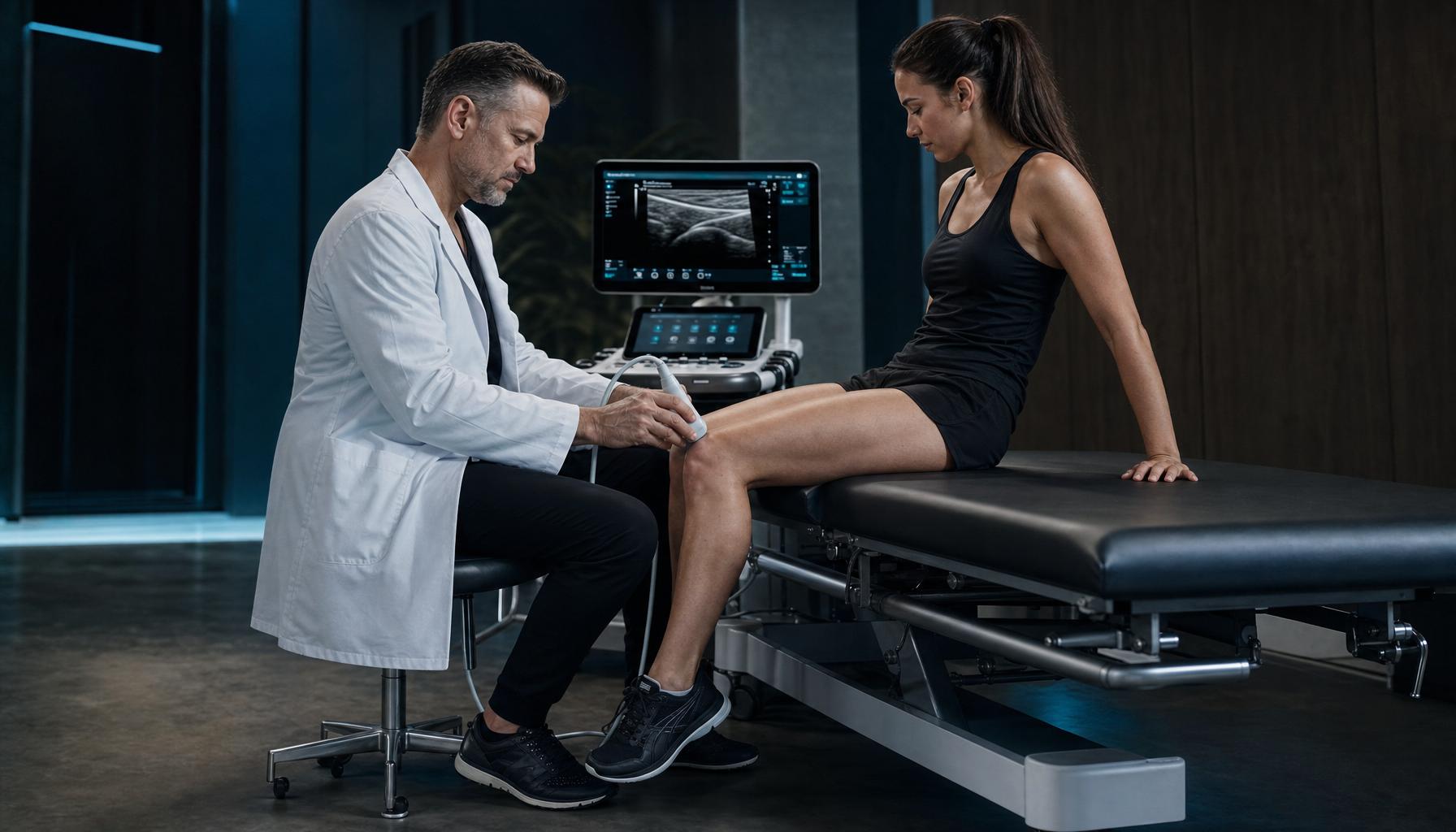
Imaging — most often musculoskeletal ultrasound, MRI when indicated, or weight-bearing X-ray for joint disease — establishes the anatomic basis for the indication. It rules out conditions that require surgical or oncologic management. It informs whether the regenerative protocol can deliver to the right tissue, and whether image guidance is required.
Laboratory work establishes baseline inflammatory state, metabolic function, micronutrient status, and (where relevant) coagulation parameters. Functional testing — range of motion, strength, gait, validated outcome scales — gives us a measurable starting point. We document the baseline; we re-measure at defined reassessment points; we adjust the protocol on what we observe, not on what we hoped for.
03 What the research shows
What the studies show.
Diagnostic-led care is the standard of care across orthopedic, internal, and regenerative medicine. The published outcomes in regenerative protocols — including those we cite on this site — are produced almost exclusively in imaging-confirmed, indication-defined patient cohorts. Treatment without diagnosis is not regenerative medicine; it is guesswork.
-
Imaging in regenerative medicine for osteoarthritis: position paper
An expert position paper laying out imaging criteria for patient selection in regenerative protocols. Imaging-confirmed Kellgren-Lawrence grading and structural assessment are required for predictable outcomes; treatment without imaging produces inconsistent and unverifiable response data.
Read on PubMed -
Musculoskeletal ultrasound in regenerative medicine: scope and applications
A comprehensive review of MSK ultrasound for tendon, ligament, and joint assessment in regenerative practice. Ultrasound provides real-time, dynamic visualization superior to static MRI for many soft-tissue indications, and is the standard for image-guided injection.
Read on PubMed -
Functional outcome measures in orthopedic and regenerative practice
Validated functional and patient-reported outcome measures (KOOS, WOMAC, DASH, NPRS) are required for documenting baseline status, measuring response, and informing protocol adjustment. Regenerative outcomes are only as reliable as the measurement framework around them.
Read on PubMed
We do not run diagnostic theater — labs and imaging that exist to justify treatment we wanted to recommend anyway. The workup is what tells us whether to proceed at all, and what to do if we find something that requires a different specialist instead.
04 Are you a candidate
Who's a candidate. Who isn't.
Candidates:
- Every patient considering a regenerative protocol at Apex.
- Patients whose prior imaging is recent and complete (we review before duplicating).
- Patients whose insurance covers the imaging and labs (we coordinate billing).
- Patients seeking an honest second opinion before committing to surgery or a regenerative protocol elsewhere.
When we will not recommend it:
- We do not skip the workup — there is no "abbreviated" diagnostic path at Apex.
- Patients unwilling to share prior imaging with the clinic.
- Patients expecting a treatment recommendation before a workup is complete.
Think you might be a candidate?
The first step is a 60–90 minute consultation. We review your imaging, history, and goals — and tell you honestly whether this is the right next step.
05 A patient experience
Dr. Abdullah is the doctor you'll want to have. Patient, calm, listens attentively. I'll wholeheartedly recommend this place to my family and loved ones.
Mickhail Bobga Google · 5.0
07What happens at your consultation
A conversation, not a sales meeting.
-
01
Intake & history
60–90 minutes. We review imaging, prior treatments, current medications, and goals. Most of this hour is listening.
-
02
Focused exam
A clinical exam tailored to your indication. Range of motion, strength, functional testing — what the literature actually predicts response on.
-
03
Honest candidacy review
If we think you're a candidate, we'll tell you why. If we don't, we'll tell you what we'd recommend instead — surgery, PT, watchful waiting.
-
04
Written plan & pricing
A defined treatment plan with modality, sequence, follow-up cadence, and total cost — before any commitment.
06 What treatment looks like
What treatment looks like.
A typical workup begins at the initial 60–90 minute consultation, where we review prior imaging, history, medications, and goals. Targeted imaging and labs are ordered against the specific indication — not as a panel. Imaging is performed in-clinic when feasible (MSK ultrasound) or coordinated through a partnered imaging center (MRI).
Most workups complete within 7–14 days of the initial visit. We sit down with the patient — in person or by video — to review the findings, walk through what they mean, and present a written treatment plan with sequence, follow-up cadence, and total cost. No protocol begins until the workup is complete and the patient has had time to consider it.
09 Common questions
Diagnostics & Workup, answered.
Why is a diagnostic workup required?
Because regenerative therapy without a diagnosis is guesswork. Every published outcome we cite — and every protocol we run — depends on imaging-confirmed indications. We don't inject blind, we don't recommend without a baseline, and we don't promise outcomes we have no way to measure.
Is the workup covered by insurance?
Imaging and labs are often billable through your insurance, particularly when the indication justifies medical necessity. We coordinate billing with the imaging center or your insurer. For patients without coverage, we discuss out-of-pocket cost in writing before any commitment.
How long does it take?
Most workups complete within 7–14 days of the initial consultation. Same-day MSK ultrasound is often possible. MRI scheduling depends on the imaging center.
What if I have prior imaging or labs?
Bring them. We review and reuse what is recent and complete. We do not duplicate imaging that already answers the question — we order new studies only where the existing data is insufficient.
Can my own provider order the imaging?
Yes, in many cases. We can coordinate with your primary care physician, orthopedist, or rheumatologist to either order the studies or share existing records. We send our diagnostic findings back to your treatment team after the visit.
What if the workup finds something unexpected?
We tell you what we found, what it means, and what specialist should see it next. We will refer out for any finding that falls outside our scope — surgical pathology, oncologic concern, or systemic disease that requires another team. Diagnostic honesty is the point of the workup.
10 Coverage & cost
Imaging and labs are often billable through your insurance — we coordinate billing through the imaging center and provide superbills for out-of-network claims. For uninsured workup, pricing is discussed in writing before any imaging is ordered. The consultation itself is a flat fee, disclosed at booking.
Begin with a consultation.
Begin with a 60–90 minute consultation. We review prior imaging and history, define the targeted workup, and walk through what we expect to find — before any protocol is recommended.