Wrist & hand arthritis
Thumb CMC arthritis, wrist osteoarthritis, and carpal-tunnel-related nerve irritation. The protocols patients delay longest — and where targeted PRP and exosome work has some of the strongest 1-year data in the literature.

- Class
- Joint · nerve
- Approach
- Ultrasound-guided
- Materials
- PRP · exosome · MSC
- Imaging
- X-ray + ultrasound
01 About
What hand arthritis looks like.
The thumb CMC joint (carpometacarpal — base of the thumb) is the most commonly affected joint in the hand, particularly in adults over 50 and women post-menopause. It presents as deep base-of-thumb pain with pinch, grip, and precision tasks. Wrist OA is similar — pain with load-bearing, grip weakness, and stiffness.
Carpal tunnel syndrome is a different mechanism: median nerve compression at the wrist, presenting with numbness, tingling, and weakness in the thumb-index-middle finger distribution. Conventional pathways for both run from splinting and PT to corticosteroid injection to surgical release or arthroplasty.
02 How it works
How regen helps the hand.
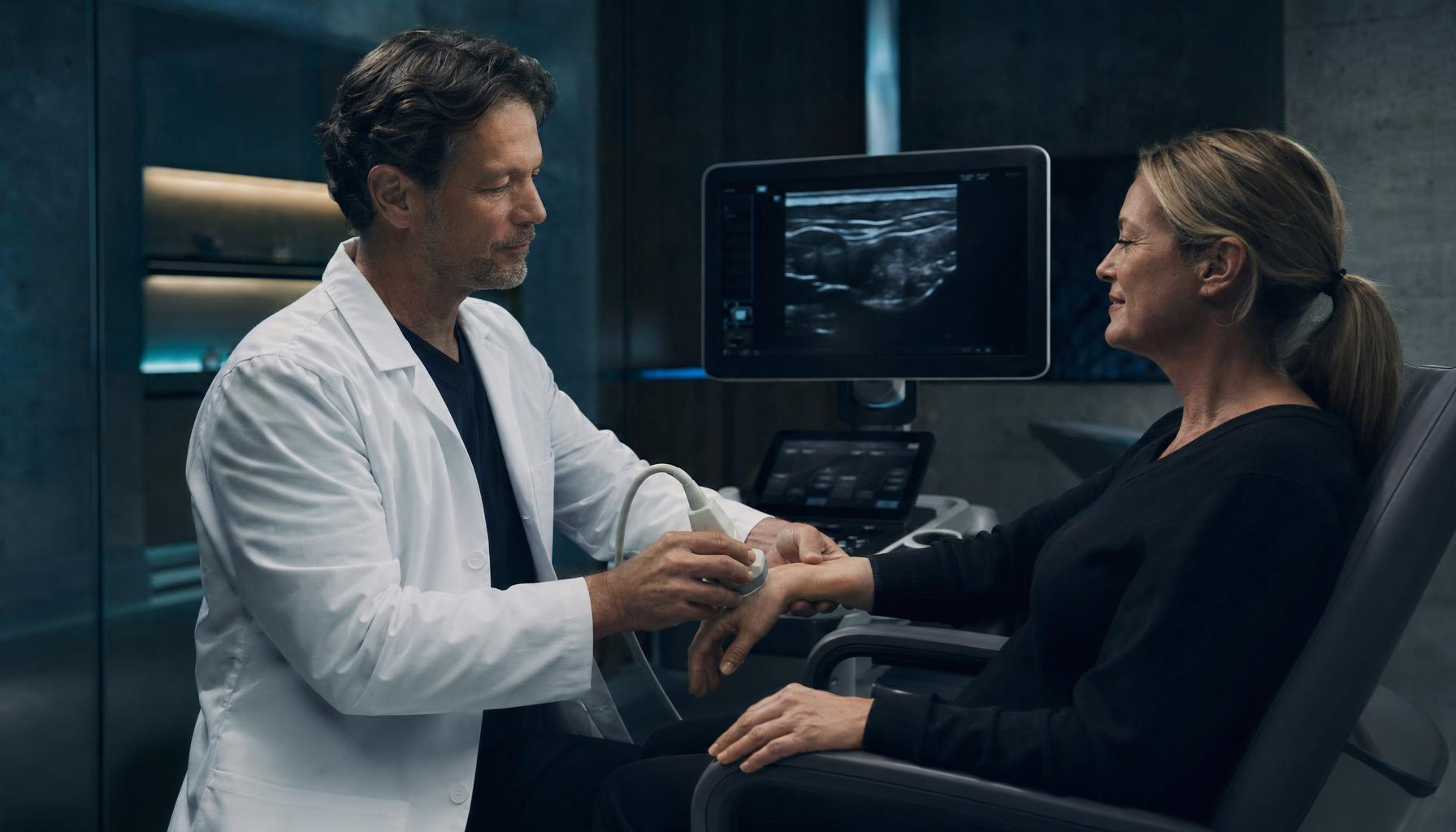
For thumb CMC and wrist OA, ultrasound-guided intra-articular injection of PRP or exosome material modulates joint inflammation and supports remaining cartilage — the same mechanism as in larger joints. For carpal tunnel, ultrasound-guided perineural PRP or exosome injection around the median nerve has been shown to reduce nerve cross-sectional area on imaging while improving symptoms.
Hand work demands extreme image guidance precision — these joints and nerves are millimeters in size. We use ultrasound for every hand procedure.
03 What the research shows
What the studies show.
Hand and wrist regenerative work has a smaller but increasingly favorable evidence base. Thumb CMC and carpal tunnel each have at least one strong randomized trial showing meaningful clinical improvement at 12 months.
PRP vs. Corticosteroid for Thumb CMC Arthritis (Malahias et al.)
33 patients with Eaton-Littler grade I–III thumb CMC arthritis were randomized to two ultrasound-guided PRP injections or two corticosteroid injections. At 12 months, the PRP group continued to show significant improvements in pain and function — while the corticosteroid group had returned to near-baseline levels. The clearest long-term advantage signal in hand regenerative literature.
Read on PubMed CentralSix-Month Efficacy of PRP for Carpal Tunnel Syndrome
60 patients with CTS were randomized to a single ultrasound-guided PRP injection or night splinting. At 6 months, the PRP group had significant reductions in pain (VAS), symptom severity (BCTQ), and median nerve cross-sectional area on ultrasound — meaningful structural and clinical improvement.
Read on NatureEffectiveness of PRP for Carpal Tunnel Syndrome: Meta-Analysis of RCTs
A meta-analysis of 8 randomized trials (220 patients) of PRP injection for CTS showed significantly lower symptom severity and functional disability scores in the PRP group versus controls — confirming the single-trial findings across the broader evidence base.
Read on PubMed Central
Hand work has shorter recovery and lower risk than larger joints — but the same candidacy logic applies. We will tell you when surgical release or arthroplasty is the better answer.
04 Are you a candidate
Who's a candidate.
Candidates:
- Eaton-Littler grade I–III thumb CMC arthritis with daily pain.
- Mild-to-moderate wrist OA limiting grip and precision tasks.
- Mild-to-moderate carpal tunnel syndrome confirmed clinically and (often) electromyographically.
- Patients who want to delay surgical release or arthroplasty.
When we will not recommend it:
- Severe end-stage thumb CMC OA where arthroplasty is the right answer.
- Severe carpal tunnel with significant axonal damage on EMG.
- Acute traumatic ligament injury requiring surgical repair.
- Patients with active joint infection or untreated coagulopathy.
Think you might be a candidate?
The first step is a 60–90 minute consultation. We review your imaging, history, and goals — and tell you honestly whether regenerative therapy is the right next step.
05 A patient experience
Dr. Abdullah is the doctor you'll want to have. Patient, calm, listens attentively. I'll wholeheartedly recommend this place to my family and loved ones.
Mickhail Bobga Google · 5.0
07What happens at your consultation
A conversation, not a sales meeting.
-
01
Intake & history
60–90 minutes. We review imaging, prior treatments, current medications, and goals. Most of this hour is listening.
-
02
Focused exam
A clinical exam tailored to your indication. Range of motion, strength, functional testing — what the literature actually predicts response on.
-
03
Honest candidacy review
If we think you're a candidate, we'll tell you why. If we don't, we'll tell you what we'd recommend instead — surgery, PT, watchful waiting.
-
04
Written plan & pricing
A defined treatment plan with modality, sequence, follow-up cadence, and total cost — before any commitment.
06 What treatment looks like
What treatment looks like.
A typical hand protocol begins with consultation, X-ray (for OA), ultrasound (for nerve assessment), and a focused exam. Treatment is ultrasound-guided injection — intra-articular for OA, perineural for carpal tunnel. Recovery is minimal: most patients return to office work the next day with light splinting if needed.
Reassessment at 6 weeks, 3 months, 6 months, and 12 months. Functional testing (DASH, BCTQ for CTS) tracks recovery. The hand often shows the slowest visible response — give it time.

09 Common questions
Common questions, answered.
Can this help arthritis at the base of my thumb?
Yes — thumb CMC arthritis has some of the strongest published 12-month outcomes in hand regenerative work, particularly with PRP.
Does this work for carpal tunnel?
Yes for mild-to-moderate cases. Severe carpal tunnel with axonal damage on EMG usually needs surgical release — and we'll tell you that honestly.
Will I be able to grip during recovery?
Light grip within 24–48 hours; full grip strength returns over 2–4 weeks.
Is this an alternative to thumb arthroplasty?
For Eaton-Littler grade I–III, yes. End-stage thumb CMC disease is generally surgical.
How is precision ensured?
Every hand procedure uses ultrasound guidance. These joints and nerves are millimeters in size — precision is non-negotiable.
What are the risks?
Mild post-injection soreness for 24–48 hours. Hand procedures are among the lowest-risk regenerative work we do.
08 Coverage & cost
Most regenerative protocols at Apex are not covered by insurance — we discuss pricing directly, in writing, before any commitment. Softwave shockwave is the exception: covered by Medicare Parts A & B with supplement (not by Medicare Advantage). Financing options are available for protocols not covered. We never hold a pricing conversation until we know you're a candidate.
Begin with a consultation.
A conversation about your hand, your imaging, and whether regenerative therapy is the right tool for your specific pain pattern.