
Hair restoration
Exosome-led protocols for androgenic alopecia and post-procedural hair loss. A focused, low-risk biologic application — different evidence base from joint-level work, evaluated separately.

- Class
- Dermal · exosome-led
- Approach
- Scalp microinjection
- Materials
- Exosome · PRP
- Setting
- In-clinic, brief recovery
01 About
What we treat in this category.
The most common indication is androgenic alopecia — the hereditary, progressive thinning that affects most adults to some degree (more visibly in men, but very common in women, particularly post-menopause). Other use cases include post-procedural or post-surgical hair loss, traction alopecia, and select forms of telogen effluvium.
Standard pharmacologic options are minoxidil (topical) and finasteride (oral, men). Surgical options include FUE and FUT hair transplantation. Regenerative protocols sit alongside or before transplantation — supporting the existing follicles, extending their growth phase, and densifying coverage.
02 How it works
Why exosomes lead this protocol.
Hair follicles are highly responsive to growth-factor signaling. Exosomes — particularly MSC-derived — carry concentrated regulatory signals (microRNA, growth factors, proteins) that activate dormant follicles, prolong the anagen (growth) phase, and increase follicle density. Several mechanistic studies show clear effects on hair-follicle stem-cell populations.
Exosome therapy has emerged as the leading regenerative option for hair restoration — outperforming PRP in head-to-head studies and requiring fewer treatment sessions. We typically use MSC-derived exosomes for hair work, sometimes paired with PRP in a combination protocol.
03 What the research shows
What the studies show.
Hair restoration evidence has grown substantially over the past three years — particularly for exosome therapy, which has emerged as the most promising single biologic for androgenic alopecia.
Effectiveness of Exosome Treatment in Androgenetic Alopecia
A prospective study of MSC-derived exosome therapy in patients with androgenetic alopecia. Treatment produced substantial increases in hair density (9.5–35 hairs/cm²) and hair-shaft thickness (up to 13.01 µm). Patient satisfaction was high, with no serious adverse events. The strongest single-arm evidence to date.
Read on SpringerExosome Therapy vs. PRP vs. Minoxidil for Androgenetic Alopecia
A systematic review compared exosome therapy, PRP, and minoxidil for androgenic alopecia. Exosome therapy emerged as the most promising treatment — superior regenerative potential, fewer sessions required, and longer-lasting effect. The review consolidated 14 RCTs and supporting studies.
Read on PubMed CentralSystematic Review of Exosome Treatment in Hair Restoration
A focused review of exosome therapy in hair restoration covering preliminary evidence, safety, and future directions. The review consolidates the consistent positive efficacy signal across studies, identifies the optimal MSC source for exosomes, and outlines protocol considerations for hair-specific applications.
Read on Wiley
Hair restoration is one of the most consistently positive regenerative indications. Exosome therapy in particular has emerged with the strongest evidence — and the clinical experience aligns. (Real Apex patients have come in specifically for this protocol with strong outcomes.)
04 Are you a candidate
Who's a candidate.
Candidates:
- Men or women with mild-to-moderate androgenic alopecia who still have meaningful follicle density.
- Patients seeking adjunct therapy alongside or instead of minoxidil/finasteride.
- Pre- or post-hair-transplant patients seeking to optimize results.
- Post-procedural or post-surgical hair loss in early stages.
When we will not recommend it:
- End-stage alopecia (Norwood VI–VII, Ludwig III) — surgery is the appropriate path.
- Active scalp infection or inflammatory skin disease.
- Patients with autoimmune alopecia (alopecia areata) requiring different management.
- Patients seeking a single-treatment "cure" — this is a maintenance therapy.
Think you might be a candidate?
The first step is a 60–90 minute consultation. We review your imaging, history, and goals — and tell you honestly whether regenerative therapy is the right next step.
05 A patient experience
Apex Regenerative is one of the best regenerative medicine clinics in Dallas. I came in for exosome therapy for hair restoration and the results have been amazing. The staff truly cares about their patients.
Grant Vaughan Google · 5.0
07What happens at your consultation
A conversation, not a sales meeting.
-
01
Intake & history
60–90 minutes. We review imaging, prior treatments, current medications, and goals. Most of this hour is listening.
-
02
Focused exam
A clinical exam tailored to your indication. Range of motion, strength, functional testing — what the literature actually predicts response on.
-
03
Honest candidacy review
If we think you're a candidate, we'll tell you why. If we don't, we'll tell you what we'd recommend instead — surgery, PT, watchful waiting.
-
04
Written plan & pricing
A defined treatment plan with modality, sequence, follow-up cadence, and total cost — before any commitment.
06 What treatment looks like
What treatment looks like.
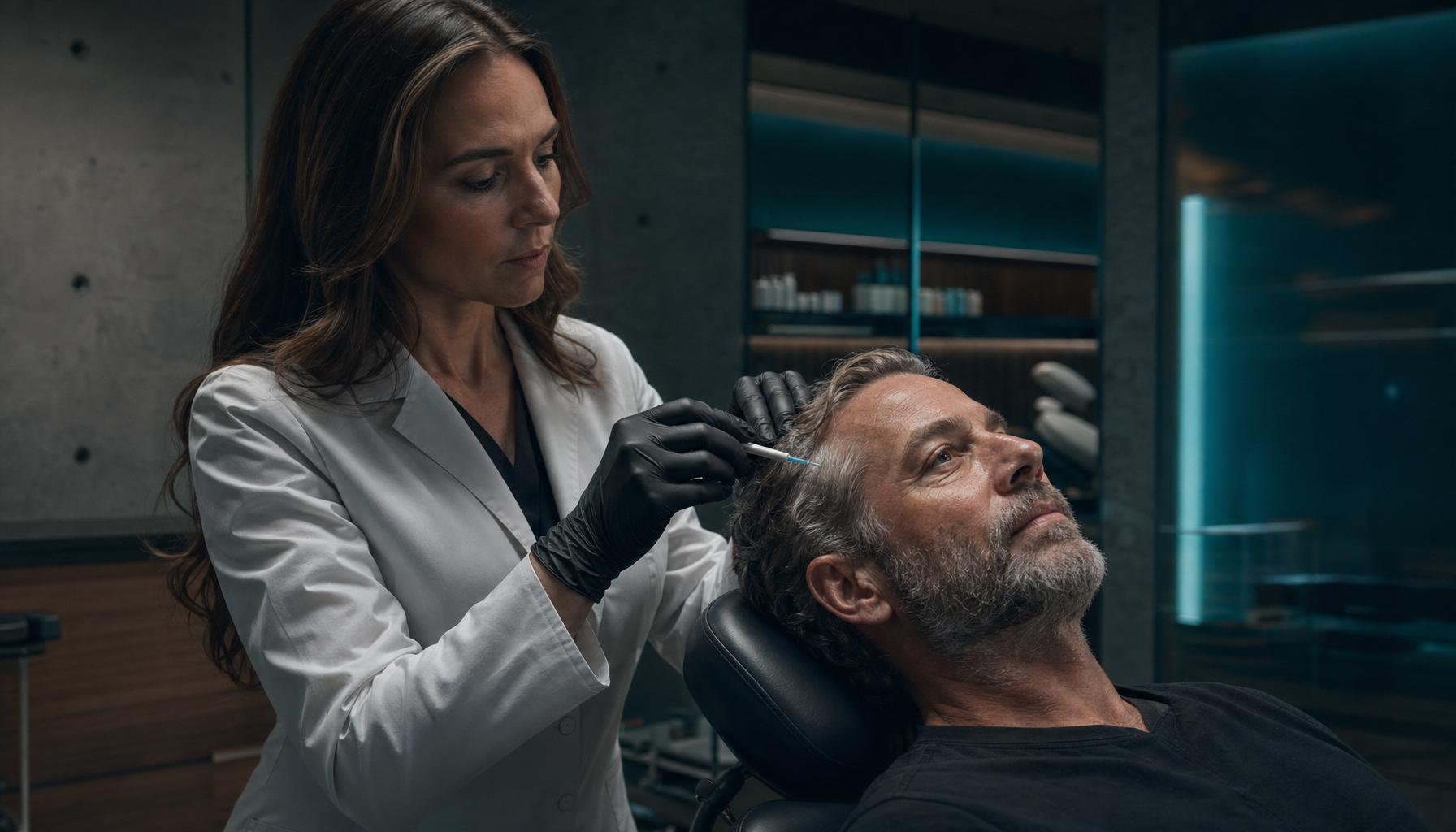
A typical hair protocol is a series of in-clinic scalp microinjections — usually two to three sessions spaced two to three months apart. Each session takes 30–45 minutes and recovery is minimal: most patients return to work the same day. We use exosome material primarily, occasionally combined with PRP for select patients.
Reassessment at 3 and 6 months. Standardized photography, hair-density assessment, and patient-reported satisfaction. Maintenance dosing is individualized.

09 Common questions
Common questions, answered.
How is this different from PRP I had elsewhere?
Exosome therapy is the newer, stronger biologic for hair. Head-to-head studies show greater density and longer-lasting effects than PRP alone.
Will my hair grow back?
Realistic expectation: thicker existing hair, slowed loss, modest density gains. Not transplant-level coverage in advanced disease.
How many sessions will I need?
Typically 2–3 sessions spaced 2–3 months apart, with maintenance dosing thereafter.
Can I still use minoxidil/finasteride?
Yes. Regenerative therapy complements topical and oral therapy — they work on different pathways.
Is this an alternative to a hair transplant?
For mild-to-moderate alopecia, often yes. End-stage Norwood VI–VII is generally surgical territory.
What are the risks?
Mild scalp redness and tenderness for 24 hours is most common. Serious adverse events are rare in the published exosome literature.
08 Coverage & cost
Most regenerative protocols at Apex are not covered by insurance — we discuss pricing directly, in writing, before any commitment. Softwave shockwave is the exception: covered by Medicare Parts A & B with supplement (not by Medicare Advantage). Financing options are available for protocols not covered. We never hold a pricing conversation until we know you're a candidate.
Begin with a consultation.
A conversation about your hair, what you've already tried (minoxidil, finasteride), and whether exosome therapy is the right next step — alongside or before any surgical option.